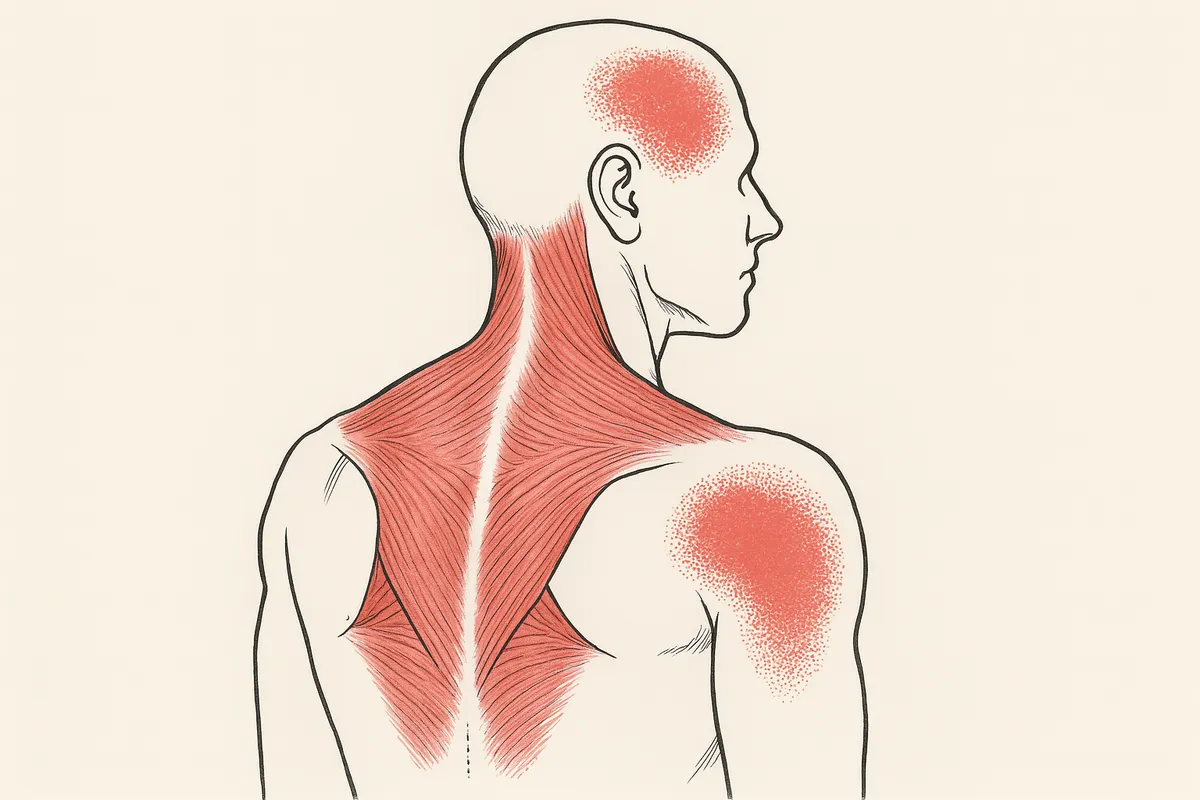
Part 2.1: Head & Neck — The Trapezius Muscle

If you’ve ever felt a dull ache in your upper back or a nagging headache at the base of your skull, there’s a good chance you’ve got the trapezius to thank for it.
This muscle is a classic culprit when it comes to myofascial pain and referred pain patterns — and yet, most people don’t really know what it does, where it sits, or how it can wreak havoc when neglected.
Where Is the Trapezius?
The trapezius — or trap for short — is a big, kite-shaped muscle that spans a large area of your upper back and neck. If you picture someone shrugging their shoulders, you’re looking at the trapezius in action.
Anatomically, the trapezius has three main parts:
- Upper fibers: These run from the base of your skull down to your shoulder tips.
- Middle fibers: These stretch horizontally across your upper back.
- Lower fibers: These run diagonally down your mid-back, anchoring to your spine.
Together, they form a broad diamond shape that connects your head, neck, shoulders, and upper spine — making the trapezius one of the most important postural and movement muscles in your upper body.
What Does the Trapezius Do?
The trapezius is the multitasker of your upper body. It helps you:
- Lift and rotate your shoulder blades (think shrugging or raising your arms).
- Stabilize your neck and head as you look around.
- Maintain good posture when you’re sitting or standing.
But because it does so much, it’s also one of the first muscles to complain when your posture slips or your stress levels go up.
The Trap’s Pain Patterns — It’s Sneakier Than You Think
Trigger points in the trapezius are among the most common I see — and they can be surprisingly intense. Here’s how its pain patterns show up:
Upper trapezius:
- The upper fibers are notorious for creating a deep, aching pain that can spread from the top of your shoulder up the side of your neck.
- Many people experience this as a classic tension headache — pain radiating to the base of the skull and sometimes up into the temple or behind the eye.
Middle trapezius:
- These fibers tend to cause pain right between the shoulder blades, a spot where people often feel they have a “knot” that just won’t release.
- It can feel like a dull ache or a burning tension after long periods at a desk.
Lower trapezius:
- Trigger points here can create pain that runs down into the middle back or even mimic pain from other muscles in the shoulder area.
- This part of the muscle is often weak and overworked if the upper traps are doing too much.
Why Does It Get So Tight?
If you spend your days hunched over a laptop, staring down at your phone, or gripping a steering wheel, your trapezius is working overtime. Add in stress — which naturally makes us raise our shoulders — and you have a perfect recipe for trigger points to form.
Once these knots develop, they can limit your range of motion, pull your posture even more out of balance, and feed the cycle of referred pain and headaches.
The Takeaway
If you’re battling upper back tension, neck stiffness, or those classic tension headaches that seem to come from nowhere, don’t underestimate the trapezius. Knowing how this big, essential muscle works — and where its pain tends to travel — is the first step toward unwinding the tension for good.
Next Up
In Part 2.2, we’ll move on to the Sternocleidomastoid — another neck muscle with a reputation for producing pain in some surprising places, from earaches to eye pain.
SAC Massage
Sacramento Massage & Trigger Point Therapy
Ready to relieve tension in your upper back and neck?
Schedule a targeted trigger point therapy session at our Midtown Sacramento studio.