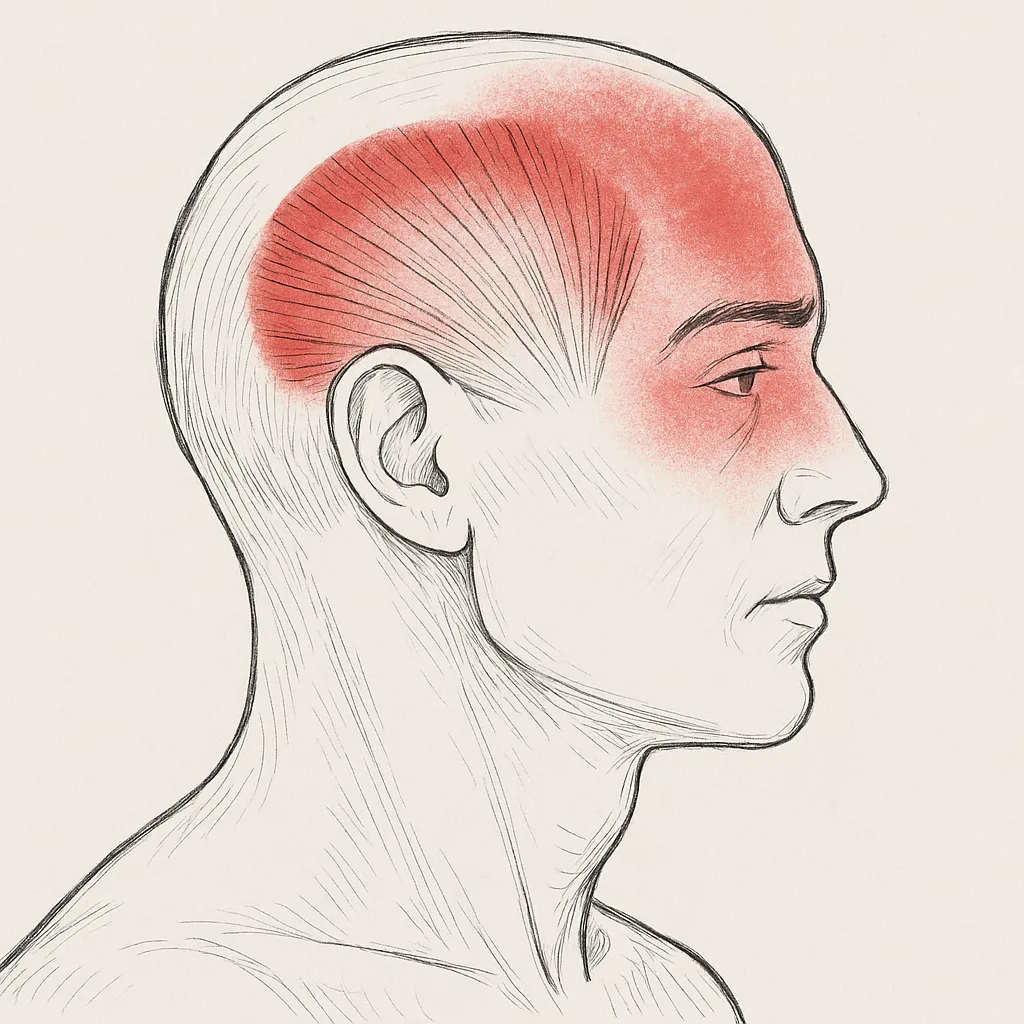
Part 2.4: Head & Neck — The Temporalis Muscle

When people think about jaw tension or headaches, they often overlook one of the most important muscles involved: the temporalis. This fan-shaped muscle is a key player in chewing and clenching — and a classic contributor to tension headaches that wrap around the side of your head.
Where Is the Temporalis?
The temporalis sits on the side of your skull, just above your ear. If you place your fingers at your temples and clench your teeth, you’ll feel it flex and bulge beneath your fingertips.
It starts at the temporal bone (the side of your skull) and fans down to a tendon that slips behind the cheekbone, attaching to the upper jawbone (the coronoid process of the mandible). That’s why it’s so closely connected to your bite.
What Does the Temporalis Do?
- Elevates the jaw: It helps you close your mouth when you bite down.
- Retracts the jaw: It can pull the lower jaw backward, which stabilizes your bite.
- Works with the masseter: It shares the load of chewing, clenching, and grinding.
The temporalis is always working when you chew — but when you clench your teeth under stress or grind at night (bruxism), it can become overactive and develop trigger points.
Referred Pain Patterns: A Headache in Disguise
Trigger points in the temporalis create one of the most common — and most misunderstood — headache patterns. Here’s what they tend to do:
- Side-of-the-head headaches: Pain usually spreads like a band around the temple and side of the head.
- Eyebrow and upper teeth pain: Some people feel an ache behind the eye or even in their upper teeth. This can lead to unnecessary dental work if the true cause is muscular.
- Ear area discomfort: Tenderness just above or around the ear can also show up — adding to the confusion if someone thinks it’s an ear infection.
Many tension-type headaches are rooted in the temporalis muscle — especially in people who clench or grind their teeth at night.
Why Trigger Points Form Here
- Teeth clenching or grinding: Often linked to stress or sleep bruxism.
- Chewing on one side: Habitual gum chewing or chewing mostly on one side of the mouth.
- Forward head posture: Poor posture puts extra load on jaw muscles like the temporalis.
- Jaw misalignment: Bite imbalances can make the muscle work harder than it should.
Signs to Watch For
If you notice that your temples are always sore to the touch — or that you wake up with a headache that feels like a tight band around your head — it’s worth investigating your temporalis muscle.
The Takeaway
The temporalis does a lot of behind-the-scenes work to keep your jaw moving smoothly. But when overworked, it can be a powerful source of headaches that feel like they’re “in your brain” when they’re actually in your muscle.
Learning to release tension here, manage clenching habits, and improve posture can go a long way toward easing tension headaches.
Next Up
In Part 2.5, we’ll continue down the list of head and neck muscles — moving into the medial and lateral pterygoid muscles, which play a surprisingly big role in TMJ dysfunction and jaw pain.
SAC Massage
Sacramento Massage & Trigger Point Therapy
Tired of temple headaches and jaw tightness?
Relieve persistent temporalis tension with specialized trigger point therapy in Sacramento.