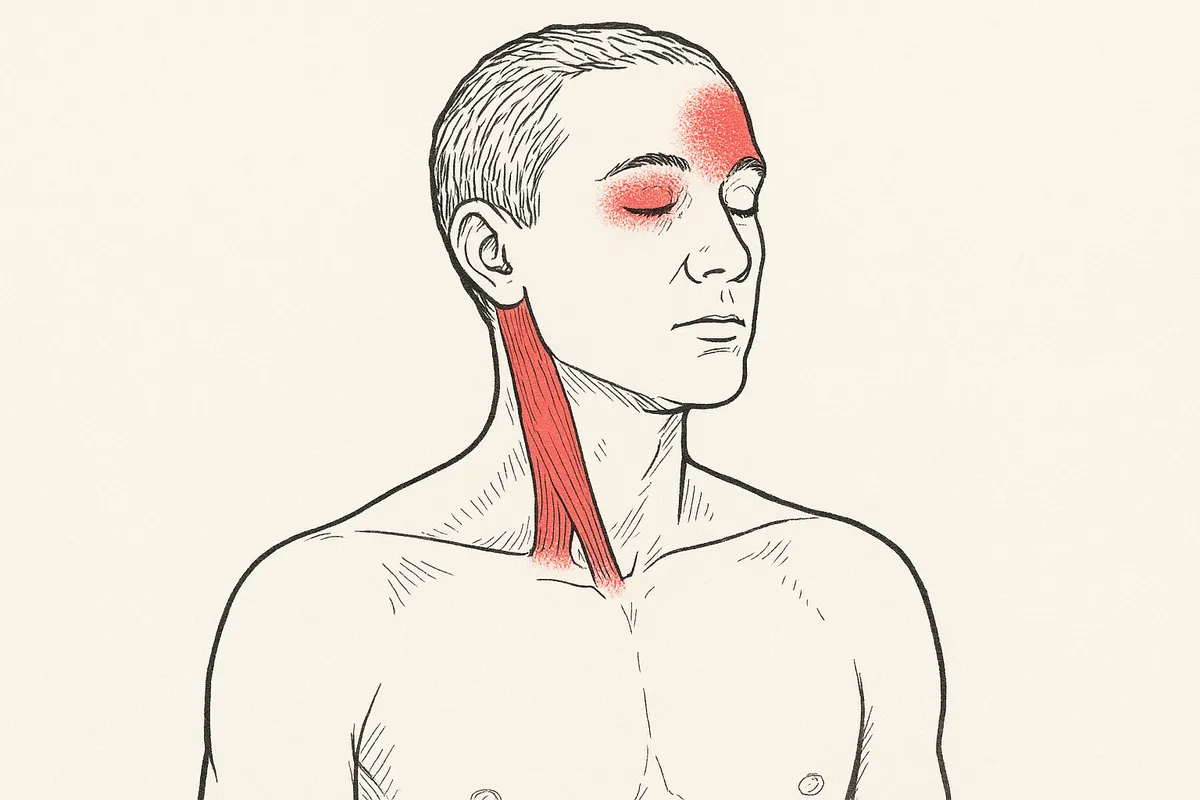
Part 2.2: Head & Neck — The Sternocleidomastoid (SCM)

If you’ve ever had pain that shoots up behind your ear, across your forehead, or even makes you feel dizzy or stuffed up — the sternocleidomastoid, or SCM for short, might be the hidden culprit.
Despite its long, intimidating name, the SCM is one of the most well-known and fascinating muscles when it comes to myofascial pain. It’s a perfect example of how one muscle can cause symptoms that seem completely unrelated at first glance.
Where Is the SCM?
The SCM is easy to find on your own neck. Place your fingers just behind your ear, then turn your head to one side and slightly tilt it back — you’ll feel a thick rope of muscle pop up from just behind your ear, down the side of your neck, and attaching near your collarbone and breastbone.
In fact, its name explains exactly where it connects:
- Sterno-: The sternum (breastbone)
- Cleido-: The clavicle (collarbone)
- Mastoid: The mastoid process (the bony bump just behind your ear)
Each side of your neck has one SCM. Together, they’re responsible for turning and tilting your head, nodding, and stabilizing your neck during almost every movement.
What Does the SCM Do?
- Rotates your head: When one SCM contracts, it turns your head to the opposite side.
- Flexes your neck: When both contract together, they bend your head forward or help tilt it to one side.
- Stabilizes your skull: They help keep your head steady when you’re driving, looking around, or working on a screen.
Because they’re constantly at work, these muscles are especially prone to developing trigger points — especially if you spend long hours looking down at your phone or holding your head at awkward angles.
Referred Pain: The SCM’s Surprising Trick
The SCM has one of the most unique referred pain patterns in the whole body. A single trigger point in this muscle can create pain and symptoms in places that might never make you suspect your neck is the cause.
Common referred pain patterns include:
- Forehead and around the eye: Trigger points can cause a tension-type headache or what feels like sinus pressure — even if your sinuses are clear.
- Top of the head: You might feel deep aches on the crown.
- Behind the ear and into the ear: Some people describe ringing in the ear (tinnitus), earaches, or a feeling of fullness that isn’t caused by an actual ear problem.
- Jaw or cheek: Pain can radiate toward the cheek or jaw, which is why SCM problems can sometimes be confused with TMJ issues.
- Dizziness and balance: Because the SCM is connected to the nerves that help regulate head position, tightness can cause mild dizziness or light-headedness.
How Does It Get Trigger Points?
SCM trigger points love to develop from:
- Forward head posture — constant looking down at phones or laptops.
- Breathing with neck muscles — when stressed, many people lift their chest to breathe, overworking the SCM.
- Sleeping positions — sleeping with your head turned to one side for long periods can overload this muscle.
- Injury or whiplash — sudden jerks, like car accidents, are classic causes.
The Takeaway
If you’ve been chasing headaches, unexplained ear symptoms, or mild dizziness with no clear cause — don’t overlook the SCM. It’s small but mighty when it comes to producing referred pain and confusing symptoms.
When you learn to release tension here and support better head posture, it can make a world of difference.
Next Up
In Part 2.3, we’ll move on to the masseter muscle — a major jaw muscle that’s tightly linked to tension headaches, facial pain, and teeth grinding.
SAC Massage
Sacramento Massage & Trigger Point Therapy
Experiencing headaches, jaw pain, or neck stiffness?
Let our trigger point therapists target the SCM and surrounding muscles in Midtown Sacramento.