Part 2.5: Head & Neck — The Pterygoid Muscles

When people talk about jaw pain and TMJ dysfunction, they often focus on the masseter or the temporalis — but the pterygoid muscles are two of the most underappreciated culprits in chronic jaw tension, headaches, and clicking jaws.
The medial and lateral pterygoid muscles sit deep within the jaw, tucked away out of sight. But don’t let their hidden position fool you — when these muscles develop trigger points, they can create pain patterns that confuse dentists, chiropractors, and clients alike.
Where Are the Pterygoids?
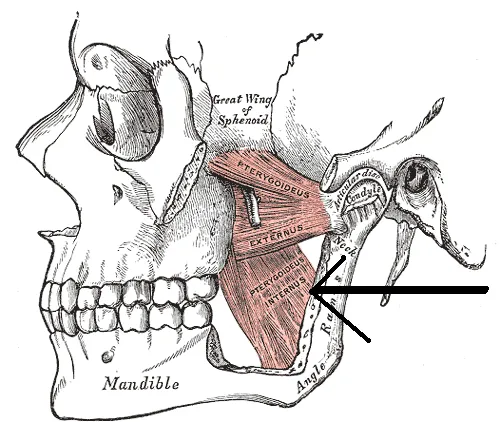
Both pterygoids are located inside the cheek, connecting the lower jaw (mandible) to the skull.
- Medial pterygoid: Think of it as a deep “partner” to the masseter, sitting on the inside of the lower jaw. It runs from the inside of the jaw up toward the sphenoid bone (deep inside the skull).
- Lateral pterygoid: This one sits even higher and more horizontally. It attaches from the jaw’s condyle (the part that moves in the jaw joint) to the sphenoid bone. It’s the only major muscle that opens the jaw forward instead of just closing it.
What Do They Do?
Medial pterygoid:
- Elevates (closes) the jaw, just like the masseter and temporalis.
- Helps grind food side-to-side by moving the jaw sideways (lateral excursion).
Lateral pterygoid:
- Protrudes (pushes forward) the jaw — essential for opening your mouth wide.
- Stabilizes the TMJ (temporomandibular joint) during chewing and talking.
These small muscles coordinate with the larger jaw muscles to create smooth, balanced motion. When they’re tight or out of balance, the whole jaw can feel off.
Referred Pain: What You Might Feel
Trigger points in these muscles can mimic a wide variety of problems:
- Deep ear pain: You might feel an ache deep in your ear canal, fullness, or ringing — even though your ear is perfectly healthy.
- Jaw pain: Soreness or stiffness when opening the mouth wide, especially if you feel a “catch” or deviation to one side.
- Teeth sensitivity: Some people report pain in the back molars, often misattributed to dental issues.
- Headaches: Tight pterygoids can contribute to tension headaches that wrap around the temples.
Common Causes of Pterygoid Trigger Points
- Clenching and grinding (bruxism): These tiny muscles work overtime when your teeth are constantly pressed together.
- Jaw trauma: Whiplash injuries, long dental procedures, or holding your mouth open for extended periods can overstretch them.
- Poor posture: Forward head posture can subtly change how your jaw rests, forcing the pterygoids to stabilize more than they should.
- Bite misalignment: Uneven dental work or missing teeth can shift how your jaw tracks.
Signs to Watch For
- Clicking, popping, or shifting when you open your mouth wide.
- Limited range of motion — feeling like you “can’t open wide enough.”
- Jaw that feels sore inside the cheek rather than on the outside.
The Takeaway
The pterygoids may be small and hidden, but they’re absolutely vital for smooth, pain-free jaw movement.
If you’re experiencing stubborn jaw pain, headaches, or ear symptoms that haven’t resolved with regular massage, it may be time to explore these deeper muscles.
Simple release techniques — like gentle intraoral trigger point therapy from a skilled practitioner — can make a world of difference.
Next Up
In Part 2.6, we’ll wrap up the Head & Neck region by covering other supportive muscles like the digastric — a fascinating muscle that can link under-chin tension with headaches and jaw dysfunction.
SAC Massage
Sacramento Massage & Trigger Point Therapy
Dealing with clicking, locking, or deep jaw pain?
Experience clinical TMJ and trigger point therapy designed to target deep pterygoid tension.