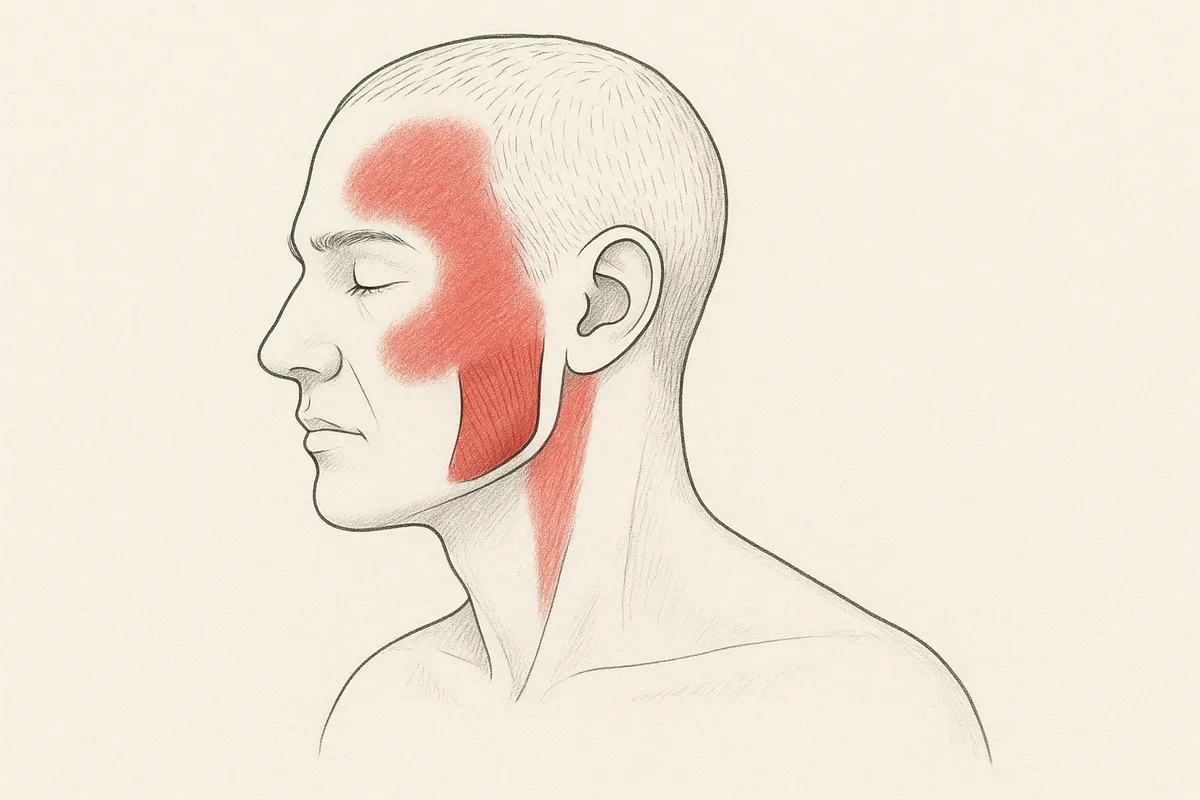
Part 2.3: Head & Neck — The Masseter Muscle

When you think about jaw pain, clenching, teeth grinding, or even tension headaches, one muscle should immediately come to mind: the masseter.
The masseter may not be a household name, but it’s one of the strongest muscles in your body by weight — and one of the most common sources of myofascial pain in the face and head.
Where Is the Masseter?
The masseter is a thick, rectangular muscle that sits at the angle of your jaw. If you place your fingers just in front of your ear and clench your teeth, you’ll feel the masseter bulge outward — that’s it in action.
You actually have two layers of masseter fibers:
- Superficial fibers, which run diagonally from your cheekbone down to your jaw.
- Deep fibers, which run more vertically and attach closer to the back of your jaw.
Its main job is simple: it closes your jaw, giving you the power to bite and chew.
What Does the Masseter Do?
- Elevates the jaw: It’s the prime mover when you clench your teeth.
- Stabilizes your bite: Keeps your jaw aligned when you chew, talk, or grind your teeth.
- Absorbs stress: During times of stress or frustration, many people unconsciously clench or grind — which overworks the masseter day and night.
Referred Pain: Why the Masseter Is So Important
Trigger points in the masseter can cause pain that travels surprisingly far beyond your jaw:
- Jaw pain: Obvious, but the whole lower face can ache — especially when chewing or talking a lot.
- Teeth pain: You may feel toothaches without cavities — many unnecessary dental procedures have been done because of this!
- Ear pain: The masseter’s pain pattern can extend into the ear canal, creating a sense of fullness, ringing, or even itching.
- Headaches: Tension headaches at the temples and along the eyebrow ridge are classic signs.
- Sinus-like pressure: Some people feel fullness or pressure in the cheek area, mistaking it for sinus congestion.
It’s a classic example of how a small muscle can mimic bigger problems.
What Creates Masseter Trigger Points?
- Teeth grinding (bruxism) — whether during sleep or when concentrating.
- Jaw clenching — especially in stressful situations.
- Chewing tough foods — gum, steak, or even habitual chewing on one side.
- Dental work — keeping your mouth wide open for long procedures can overload the masseter.
- Poor posture — believe it or not, head-forward posture can increase jaw tension.
Signs Your Masseter Might Be the Culprit
If you wake up with a sore jaw, have clicking or popping when you open your mouth, or feel tension around your temples, your masseter might be overworked. Some people even notice a slight asymmetry in their face because one side works harder than the other.
The Takeaway
The masseter does a lot more than help you chew — it’s deeply connected to stress and tension patterns in the head, neck, and face.
Learning to find and release masseter trigger points can make a dramatic difference for headaches, TMJ dysfunction, and that nagging feeling that your jaw is “always tight.”
Next Up
In Part 2.4, we’ll move on to the temporalis, another jaw muscle that often works hand-in-hand with the masseter to cause headaches and facial pain.
SAC Massage
Sacramento Massage & Trigger Point Therapy
Struggling with TMJ pain or jaw tension?
Our specialized trigger point therapists can help release your masseter and relieve stubborn facial tension.